|
|
 |
Rules of the Road

Did you know that bicyclists on public roadways have all the same
rights and responsibilities as motorists and must obey the same state
and local laws?
Did you know that California law requires all bicyclists and bicycle
passengers under 18 to wear helmets that meet specific safety standards?
Following are some important rules from the California Vehicle Code
(VC) relating to operating and equipping bicycles. Whether you ride
your bike occasionally or are a dedicated bicycle commuter, you
must know and follow the Rules of the Road.
Where
to Ride
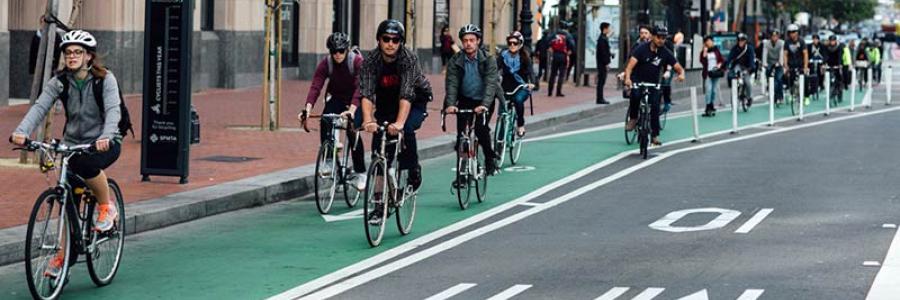
Bicycle riders on public streets have the same rights and responsibilities
as automobile drivers. Cyclists are part of the normal traffic flow
and are entitled to share the road with other drivers.
Cyclists must ride in the same direction as other traffic, not against
it. They should normally ride as near to the right curb or edge
of the roadway as practical. Not on the sidewalk.
Cyclists can legally move left to turn left, to pass a parked or
moving vehicle or another bicycle, or to make a turn, avoid debris,
an animal, or other hazards. Cyclists may ride near the left curb
or edge of a one-way street.
Turning
Cyclists make left and right turns in the same way that drivers
do, using the same turn lanes. A cyclist turning left should use
a left-turn lane. A cyclist traveling straight ahead should use
a through traffic lane rather than ride next to the curb and block
traffic making right turns.
Night Riding
Bicycles operated on highways during darkness are required to be
equipped with the following:
- a white light that illuminates the highway and is visible from
a distance of 300 feet to the front and sides of the bicycle.
(A white light attached to the bicyclist that is visible from
300 feet to the front and sides of the bicycle may be used in
place of a light attached to the bicycle.)
- a red reflector mounted on the rear of the bicycle and visible
from 500 feet to the rear of the bicycle
- a white or yellow reflector mounted on each pedal visible 200
feet to the front and rear of the bicycle, a white or yellow reflector
on each side forward of the center of the bicycle and a white
or red reflector on each side to the rear of the center of the
bicycle. Bicycles equipped with reflectorized tires on the front
and rear need not be equipped with side reflectors. All reflectors
and reflectorized tires must meet DMV requirements.
Passengers
& Packages
A passenger is allowed on a bicycle only on a separate attached
seat. If the passenger is 4 years old or younger or weighs 40 pounds
or less, the seat must adequately retain the passenger in place
and protect him/her from the bicycle’s moving parts.
A bicyclist carrying a package or bundle must keep at least one
hand on the handlebars.
Helmets
Bicyclists and bicycle passengers under 18 years old are required
to wear helmets meeting specified standards (ANSI Z 90.4 Bicycle
Helmet Standard, SNELL or The American Society for Testing Materials
ASTM F-1447 Standard) that are conspicuously labeled with those
standards. This also applies to a passenger in a restraining seat
attached to the bicycle or in a trailer towed by the bicycle. Violations
are punishable by a fine of up to $25.00.
Hand Signals
All required signals are given as follows:
a) Left turn: left hand and arm extended horizontally beyond the
side of the bicycle;
b) Right turn: left hand and arm extended upward beyond the side
of the bicycle, or right hand and arm extended horizontally.;
c) Stop or sudden decrease of speed: left hand and arm extended
downward beyond the side of the bicycle.
Headsets and Earplugs
Bicyclists are not allowed to wear a headset covering, or earplugs
in, both ears.
|
|
| ANNOUNCEMENTS |
| » |
BikeMapper is Back
Click
here to find recommended roadways and paths in your community
for your next bicycle adventure.
|
Basic Safety Tips
Every year in California over 100 people are killed and thousands
more are injured in bicycle collisions. Follow these safety tips to
help ensure that you’re not one of the statistics.
- Always wear a helmet
- Obey all traffic controls
- Ride your bicycle near the right-hand edge of the road
- Never carry another person on your bicycle
- Always use hand signals when turning or stopping
- Look out for cars at cross streets, driveways and parking places
- Be careful when checking traffic and don’t swerve when
looking over your shoulder
- Give pedestrians the right of way
- Always ride carefully.
Remember, bicyclists share a complex traffic environment with other
larger forms of transportation. Children under age 9 lack the physical
and mental development to interact safely in that environment.
For more information on safe bicycling, see:
Also In This Section:
|
|